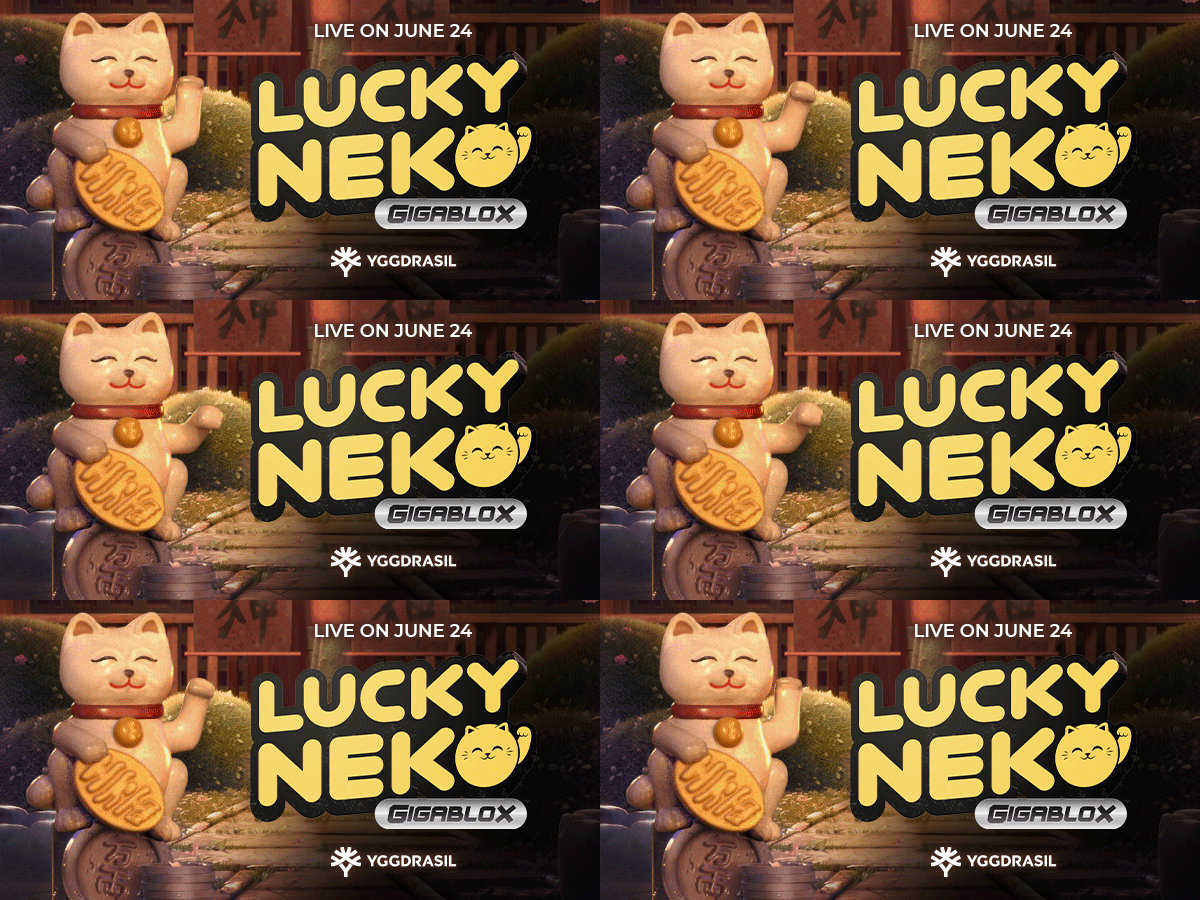
Lucky Neko is often introduced through cultural symbolism and character-driven design, yet these surface elements rarely explain how the game actually behaves during play. From an educational perspective, the value of reviewing Lucky Neko lies in understanding how its internal structure shapes outcome rhythm, expectation management, and session decision-making. The game’s design choices influence perception more than probability, making structural clarity essential.
Why the Core Theme Influences Player Interpretation
The Lucky Neko theme is built around repetition and familiarity rather than narrative progression. This choice causes players to anchor expectations to consistency instead of surprise. The cause is a visually stable environment, the outcome is reduced cognitive friction, and the impact is that players often focus more on spin frequency than on isolated high-value events.
This thematic stability does not affect randomness, but it strongly affects how outcomes are emotionally categorized. Losses feel routine rather than disruptive, while wins are processed as incremental reinforcement instead of breakthroughs.
Reel Configuration and Mathematical Framing
Lucky Neko uses a compact reel configuration with limited symbol variation. This framing narrows outcome possibilities and increases recognizability of patterns without changing probability distribution. The structure emphasizes repeat exposure over delayed resolution.
Before identifying structural characteristics, it is important to understand that mathematical framing determines how often players receive informational feedback. The following list outlines core elements that influence this feedback loop:
- Limited symbol pool increases recognition speed
- Stable reel height reduces visual noise
- Wild symbols function as amplifiers rather than primary drivers
Interpreting these points together reveals that Lucky Neko prioritizes clarity over complexity. The impact is smoother learning curves, but the limitation is reduced excitement for players seeking layered mechanics or evolving states.
Volatility Behavior and Outcome Distribution
Lucky Neko operates within a low-to-medium volatility range, but the defining factor is distribution consistency. Outcomes are spread evenly rather than clustered into rare extremes. This produces frequent small adjustments to balance rather than dramatic swings.
From a practical standpoint, this volatility profile favors controlled session planning. Players who expect sudden reversals may misjudge performance, while those who value predictability often remain engaged longer. The design rewards patience rather than timing.
Feature Mechanics and Conditional Scaling
The primary feature mechanic in Lucky Neko revolves around multiplier-based wilds that scale under specific conditions. These conditions are visible and rule-based, not random interruptions.
How conditional scaling shapes expectation
Conditional scaling requires alignment between symbol placement and multiplier activation. When alignment fails, outcomes resolve immediately. When alignment succeeds, value increases proportionally rather than exponentially. This mechanism teaches players to recognize states instead of anticipating triggers, reducing misconceptions tied to spin counts.
Comparing Lucky Neko to Other Slot Structures
Lucky Neko differs from feature-heavy slots by integrating value directly into the base game rather than isolating it in bonus modes. This creates a flatter emotional curve across sessions.
To clarify this difference, the table below compares structural emphasis rather than reward size:
| Structural Focus | Lucky Neko | Feature-Driven Slots |
| Value generation | Continuous | Event-based |
| Emotional pacing | Stable | Volatile |
| Learning curve | Short | Extended |
The interpretation of this comparison highlights a trade-off. Continuous value delivery supports consistency but limits dramatic peaks. Players seeking stability benefit, while thrill-seekers may disengage early.
Environmental Context and Access Conditions
When access conditions emphasize quick interaction and repeated sessions, Lucky Neko aligns well with simplified interfaces. In contexts where players evaluate performance across a betting interface like ufabet747 ทางเข้า, the contrast between steady-output games and high-variance alternatives becomes apparent. This observation implies that perceived generosity often reflects compatibility with session length rather than underlying payout logic.
Understanding this context prevents misattributing design intent to outcome bias and helps align expectations with structural reality.
Where Lucky Neko’s Design Reaches Its Boundary
The primary limitation of Lucky Neko appears when symbolic familiarity is mistaken for progression. Repetition can create the illusion of momentum, leading players to expect escalation that the structure does not promise.
In broader เว็บไซต์ คาสิโนออนไลน์ ecosystems, this mismatch becomes clearer as players switch between games with sharply different volatility models. Lucky Neko does not fail mathematically; it fails only when interpretation exceeds its structural scope.
Summary
Lucky Neko is structured around clarity, repetition, and controlled volatility rather than dramatic feature escalation. Its design favors predictable session flow, visible conditional mechanics, and continuous value distribution. These characteristics shape perception and decision-making without altering probability fundamentals. Evaluated through an educational lens, Lucky Neko succeeds as a stability-oriented slot while revealing clear limitations for players seeking high-impact variance.